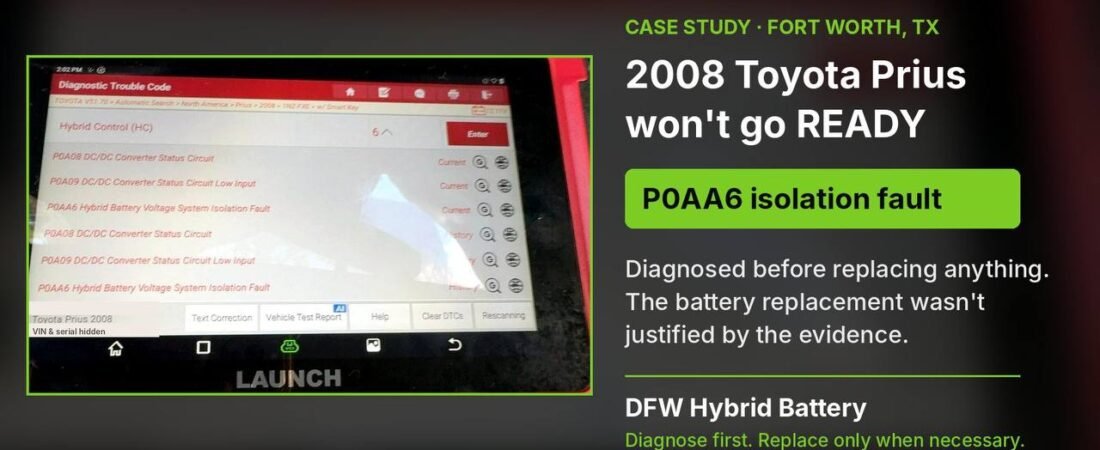
An example of Honest Hybrid Battery Diagnostics: the real strength of this job is not a repair. It is that we refused to sell an expensive hybrid battery without enough evidence that the car needed one.
Honest Hybrid Battery Diagnostics
The customer had already been told the battery was failing. The test data did not prove it — so we did not sell one. Evidence first, then a recommendation.
CASE STUDY
2008 Toyota Prius Won’t Start – P0AA6 Isolation Fault, Not a Proven Battery Failure
Vehicle: 2008 Toyota Prius (2nd generation)
Location: Fort Worth, Texas
Service: Mobile hybrid system diagnostics
DTCs: P0AA6, P0A08, P0A09, C1241, C1259, C1310
Result: A recurring high-voltage isolation fault was identified, a hybrid battery replacement was ruled out as the next step, and the customer avoided an expensive repair that had not been proven necessary.
Quick Answer
Symptom: The Prius would not start or enter READY mode, with several warning lights on the dash. The owner had been told the hybrid battery was probably failing.
Main code: P0AA6 — Hybrid Battery Voltage System Isolation Fault, plus DC/DC converter codes P0A08 and P0A09.
Key finding: Clearing the codes let the car go READY for a while, but the fault came back after shutdown. The DC/DC converter held 14.05 V (light load) and 13.95 V (A/C and headlights on).
Decision: The evidence did not show a failed hybrid battery, so we did not recommend replacing it. The next step is insulation and circuit testing of the high-voltage system.
Customer outcome: Charged for the diagnostic only, with a written report by email — and no unnecessary battery replacement.
The Customer’s Problem: A Prius That Wouldn’t Start
A customer in Fort Worth, Texas, called DFW Hybrid Battery about their 2008 Toyota Prius. The car would not start or enter READY mode, and several warning lights were on. They had already been told the hybrid battery was likely failing and were thinking about replacing the whole pack.
A hybrid battery replacement is a big expense, and in this case nobody had confirmed the actual cause. So before recommending anything, Jay came to the car and ran a full diagnostic of the hybrid electrical system.
Step 1: Reading the Hybrid System Trouble Codes
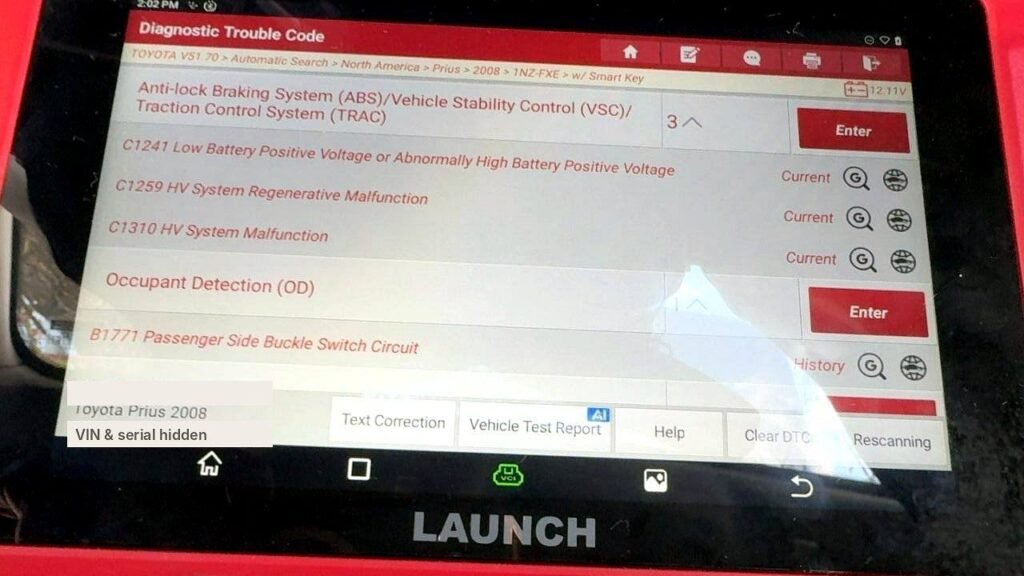
Using a professional Launch scan tool, we checked the Hybrid Control and ABS/VSC systems. These codes were stored:
| Code | Description | System |
|---|---|---|
| P0AA6 | Hybrid Battery Voltage System Isolation Fault | Hybrid control |
| P0A08 | DC/DC Converter Status Circuit | Hybrid control |
| P0A09 | DC/DC Converter Status Circuit Low Input | Hybrid control |
| C1241 | Low or abnormally high battery positive voltage | ABS/VSC |
| C1259 | HV System Regenerative Malfunction | ABS/VSC |
| C1310 | HV System Malfunction | ABS/VSC |
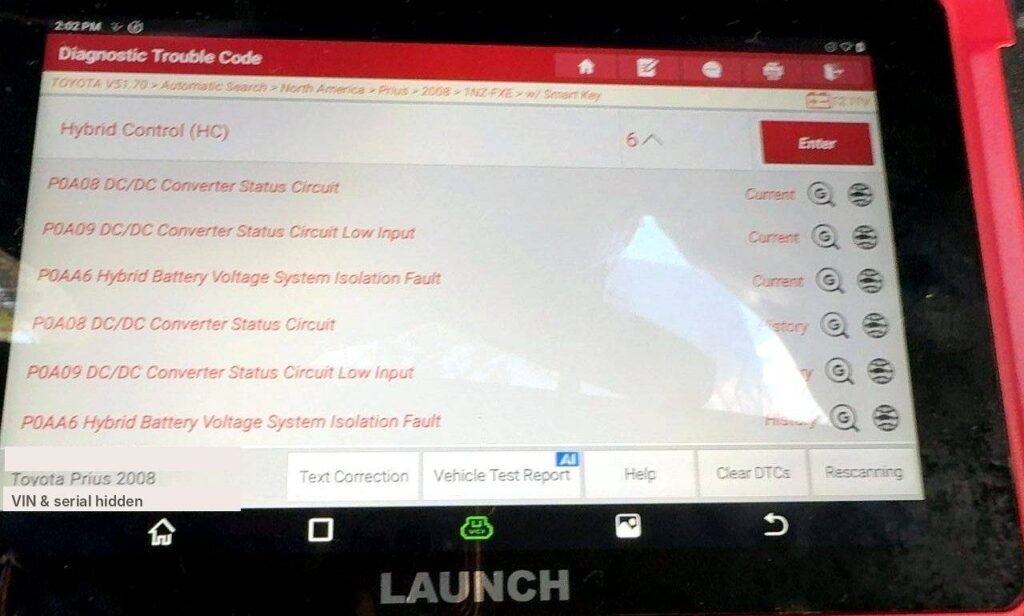
The most important finding was P0AA6: an insulation problem somewhere in the high-voltage system. Unlike codes that point to battery deterioration, P0AA6 can come from several different components:
- High-voltage wiring and connectors
- Hybrid battery components
- The inverter and converter assembly
- The motor-generators in the hybrid transaxle
- The electric A/C compressor and its circuit
The ABS/VSC codes C1259 and C1310 are the brake system reporting that the hybrid system has a fault, and C1241 relates to the 12-volt supply voltage the brake control unit sees. Replacing the battery without more testing could easily have been an expensive mistake.
Step 2: Getting READY Back — and Watching the Fault Return
After recording the codes, we cleared them to see how the car would respond. The Prius went into READY mode and the hybrid system ran for a while. Then the codes came back. Once the car was switched off, it would not go READY again unless the codes were cleared, and eventually it would not start normally at all.
That pattern is typical of a hybrid system that keeps detecting a potentially unsafe electrical condition and limits operation to protect the car and the people around it.
Important finding
Clearing the codes let the car start temporarily, but it did not repair the underlying electrical fault.
Step 3: Testing the DC/DC Converter (12-Volt Charging)
Because P0A08 and P0A09 were also set, we tested the 12-volt charging output with the car in READY mode:
| Test condition | Measured voltage |
|---|---|
| READY mode, minimal electrical load | 14.05 V |
| READY mode, A/C and headlights on | 13.95 V |
The voltage stayed stable under load, so the DC/DC converter was producing proper charging voltage during our test. The converter-related codes still needed circuit diagnosis, but the results did not justify replacing the whole inverter assembly.
Step 4: Why We Did Not Recommend a Hybrid Battery Replacement
Knowing when not to replace a battery is a big part of honest hybrid diagnostics. Here, the test results never showed that the battery pack itself had failed. The car had a recurring high-voltage isolation fault plus DC/DC converter status codes — and an isolation fault can start in many places. Without finding the exact source, replacing the battery would have been a guess, not a confirmed repair.
So instead of selling a battery, we explained the findings and recommended the next step: insulation and circuit testing of the high-voltage system by an electrical specialist experienced with Toyota hybrids.
Step 5: Explaining the Results to the Customer
We walked the customer through what we found:
- Why the car could go READY for a while after the codes were cleared
- Why the problem came back after shutdown
- What the P0AA6 isolation fault means
- Why the DC/DC converter codes need more investigation
- Why there was not enough evidence to justify a new hybrid battery
- Why insulation and circuit testing is the right next step
They also received a detailed written diagnostic report by email. Because the remaining work called for specialized electrical troubleshooting, we charged only for the diagnostic. No battery replacement or major component was sold. The customer was relieved to have a clear explanation before making an expensive decision.
The Outcome: Avoiding a Costly Mistake
The electrical fault was not repaired during this visit — but the diagnostic still saved the customer real money. They did not pay for a hybrid battery that had not been proven necessary, and they now know exactly what needs to be tested next.
A Prius that won’t start does not automatically need a new hybrid battery. That is exactly why our diagnostic is a paid, written Battery Health Report rather than a “free check” tied to selling a battery.
Why This Case Matters: Honest Hybrid Battery Diagnostics
Selling the battery would have been the easy job. The customer was already expecting it. But the evidence pointed to an isolation fault that could be somewhere else in the high-voltage system, and a battery sold on a guess is a battery sold on the customer’s money. That is the standard we work to on every car:
For drivers
You get the test data and a written report before any price quote. If the evidence does not support a battery, we will not sell you one — even when someone else already told you it was the battery.
For repair shops
Send us the hybrid car you are not sure about. We give you a documented, evidence-based answer on the high-voltage battery — including when the battery is not the problem — so your customer gets the right repair the first time.
For dealerships
An independent, second opinion on a hybrid battery before a costly replacement, with codes, voltage readings and the reasoning in writing.
Read more about how our diagnostics work and why our diagnostic isn’t “free”.
Frequently Asked Questions
What does P0AA6 mean on a Toyota Prius?
P0AA6 means the hybrid system has detected an insulation (isolation) problem somewhere in the high-voltage system — current leaking from the high-voltage circuit toward the vehicle body. The code does not say which component is at fault. It can come from high-voltage wiring and connectors, the battery assembly, the inverter/converter, the motor-generators in the transaxle or the electric A/C compressor circuit. See our P0AA6 code guide.
Does P0AA6 mean I need a new hybrid battery?
Not by itself. The battery is only one of several possible sources. Replacing it without isolating the fault is a guess, and if the leak is elsewhere the car will still have the same problem.
Why does my Prius start after clearing the codes, then stop again?
Clearing codes resets the warning, so the system may allow READY for a while. When it detects the unsafe electrical condition again, it sets the code and restricts operation. Clearing codes is a test step, not a repair.
What do P0A08 and P0A09 mean?
They relate to the DC/DC converter status circuit, the part of the inverter assembly that charges the 12-volt system. In this car the converter output tested normal under load, so those codes call for circuit diagnosis before anyone replaces the inverter.
How much is a hybrid diagnostic in Fort Worth?
Fort Worth visits are by appointment: the on-site diagnostic is $200, and 50% of it is credited toward a repair. You get a written report either way. See our hybrid battery prices.
Hybrid Diagnostics in Fort Worth, TX
DFW Hybrid Battery provides mobile hybrid battery diagnostics, repair, reconditioning, external charging and replacement across Dallas–Fort Worth, including Fort Worth, Arlington, Irving and Grand Prairie by appointment. We work with individual drivers, repair shops and dealerships. Own a second-generation Prius? See our Prius Gen 2 hybrid battery guide.
More Repair Case Studies
- 2026 Hyundai Santa Fe Hybrid — deeply discharged battery recovered, no replacement (Garland, TX)
- 2011 Lexus RX450h — full hybrid battery rebuild with 30 cycle-tested modules (Grand Prairie, TX)
- 2004 Toyota Prius — P0AA1 & P0AA4 no-READY traced to a loose connector terminal (Arlington, TX)
- 2021 Toyota Prius — deeply discharged hybrid battery recovered with external charging (Arlington, TX)
- 2017 Hyundai Sonata Hybrid — no-start diagnosis
- 2015 Hyundai Sonata Hybrid — P1B70 caused by a failed BMS
- 2006 Lexus RX400h — full hybrid battery rebuild
Technical note: Hybrid vehicle battery systems contain potentially lethal high voltage. Insulation testing, diagnosis and repair should be performed by qualified personnel using appropriate safety procedures and equipment.
Is Your Toyota Prius Not Starting?
Red triangle, hybrid system codes or no READY? Don’t assume the battery is bad. Diagnose first — replace only when necessary.
Quick Request — 30 Seconds
Four quick fields. We call or text you back.