How DFW Hybrid Battery diagnosed a no-start condition that appeared to indicate failed hybrid battery contactors—but was actually caused by a loose electrical connector terminal.
CASE STUDY
2004 Toyota Prius – No READY Mode with P0AA1 & P0AA4 Traced to a Loose Connector Terminal
Vehicle: 2004 Toyota Prius (2nd Generation)
Location: Arlington, Texas
Service: Hybrid Battery Reconditioning, Hybrid System Diagnostics & Electrical Troubleshooting
DTCs: P0AA1, P0AA4, C1259, C1310
Final Result: Vehicle successfully entered READY mode, with no recurring trouble codes.
Quick Answer
Symptom: After hybrid battery reconditioning, the 2004 Prius powered on but would not enter READY mode.
Codes: P0AA1 and P0AA4 (positive and negative hybrid battery contactor circuits stuck closed), plus C1259 and C1310 from the brake control system.
Key test: The complete battery pack went READY on the first attempt in a second Prius, with no trouble codes.
Cause: A slightly loose terminal pin in the multi-pin connector between the vehicle harness and the battery assembly.
Fix: The terminal connection was corrected and secured — no PRA, battery ECU, inverter or module replacement needed.
The Customer’s Problem: Prius Would Not Start After Hybrid Battery Service
DFW Hybrid Battery worked on a 2004 Toyota Prius in Arlington, TX, requiring hybrid battery reconditioning and subsequent troubleshooting.
The hybrid battery pack was removed from the vehicle, and its modules underwent reconditioning and evaluation.
After the battery pack was reinstalled, however, an unexpected problem appeared: the Prius would no longer enter READY mode.
The instrument cluster powered on, but the hybrid system would not activate.
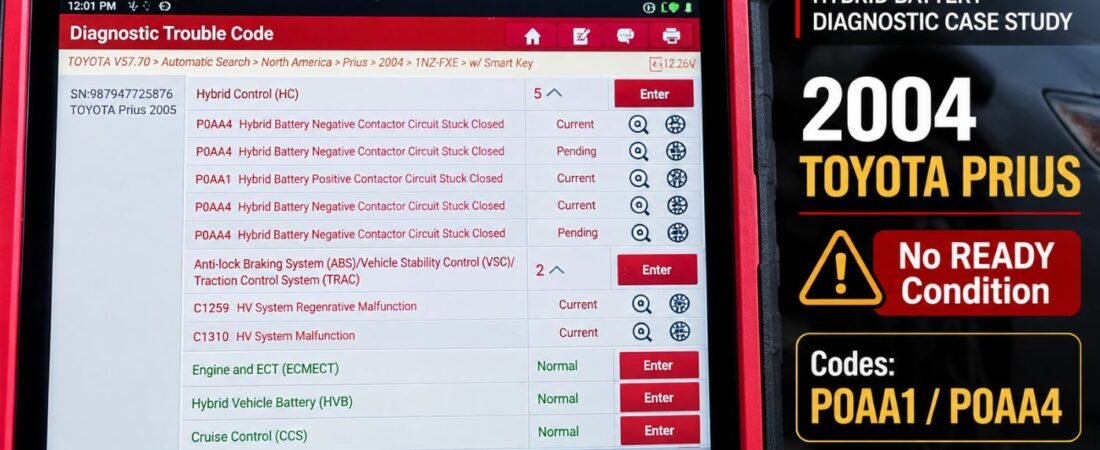
Using a Launch X431 diagnostic scanner, we identified two critical hybrid-system fault codes:
- P0AA1 — Hybrid Battery Positive Contactor Circuit Stuck Closed
- P0AA4 — Hybrid Battery Negative Contactor Circuit Stuck Closed
The vehicle also displayed C1259 and C1310, indicating that the brake control system had detected a hybrid-system malfunction. (You can look up more codes in our hybrid battery error codes guide.)
Although these codes suggested a possible problem involving the high-voltage battery contactors, additional testing was necessary before replacing expensive components.
Step 1: Verifying Hybrid Battery Voltage
Our first diagnostic step was to verify whether the hybrid battery pack was supplying sufficient voltage.
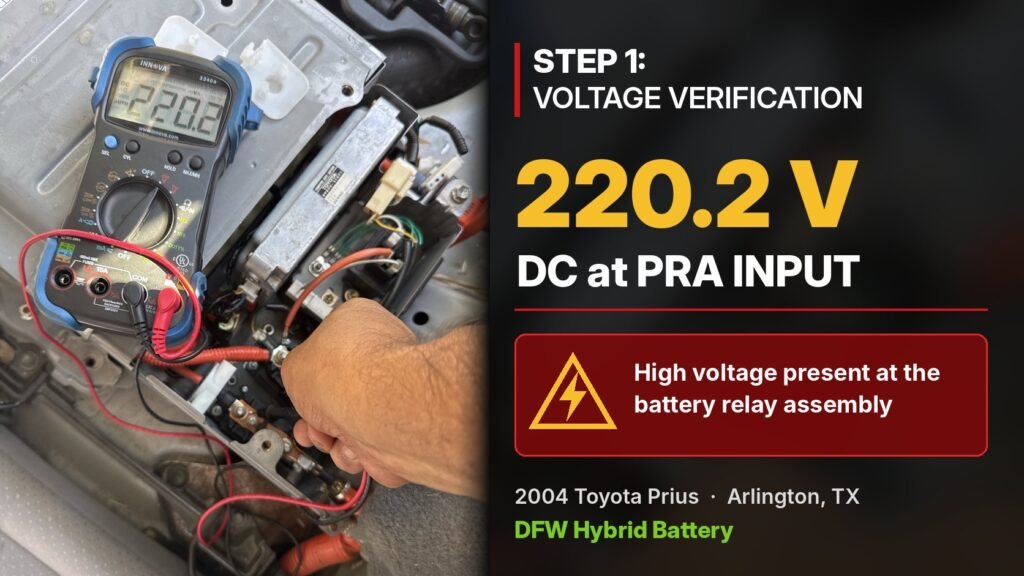
Using appropriate high-voltage diagnostic procedures, we measured approximately 220 volts DC at the input side of the battery’s Power Relay Assembly (PRA).
This confirmed that high voltage was present at the relay assembly’s input. For reference, the 2nd-generation Prius pack is a 201.6-volt (nominal) NiMH battery made of 28 modules, so a reading around 220 V on a freshly reconditioned, charged pack is within the expected range. See our Prius Gen 2 hybrid battery guide for more on this pack.
However, proper voltage alone does not guarantee that the contactors, control circuits, and associated electrical connections are functioning correctly.
Step 2: Investigating the Hybrid Battery Relays
The PRA contains high-voltage contactors that control the connection between the hybrid battery and the vehicle’s high-voltage electrical system.
During our initial troubleshooting, we observed that:
- The Prius failed to enter READY mode.
- No normal contactor engagement clicks were heard.
- Diagnostic trouble codes P0AA1 and P0AA4 remained active.
- The scanner displayed the system main relay parameter as OFF or N/A during testing.
These findings raised concerns about the relay control system.
Possible causes included defective contactors, interrupted relay control signals, wiring problems, or an issue with the vehicle’s Hybrid Control ECU.
Instead of immediately replacing the PRA or battery ECU, we continued investigating.
Step 3: Testing the Complete Hybrid Battery in Another Prius
One of the most important diagnostic steps involved testing the entire hybrid battery assembly in another compatible Toyota Prius.
The complete battery pack was transferred without replacing or modifying any components, including:
- The hybrid battery modules
- The battery control ECU
- The Power Relay Assembly (PRA)
- The internal battery wiring and related components
The second Prius entered READY mode on the first attempt, without displaying any diagnostic trouble codes.
This was the turning point in the investigation.
The successful test strongly indicated that the complete hybrid battery assembly, including its contactors and control electronics, was operating correctly. Our attention shifted away from the battery pack and toward the original vehicle’s electrical connections and relay control circuits.
Step 4: Discovering the Actual Problem
After returning to the original Prius in Arlington, we conducted another detailed inspection of the vehicle-side electrical connections.
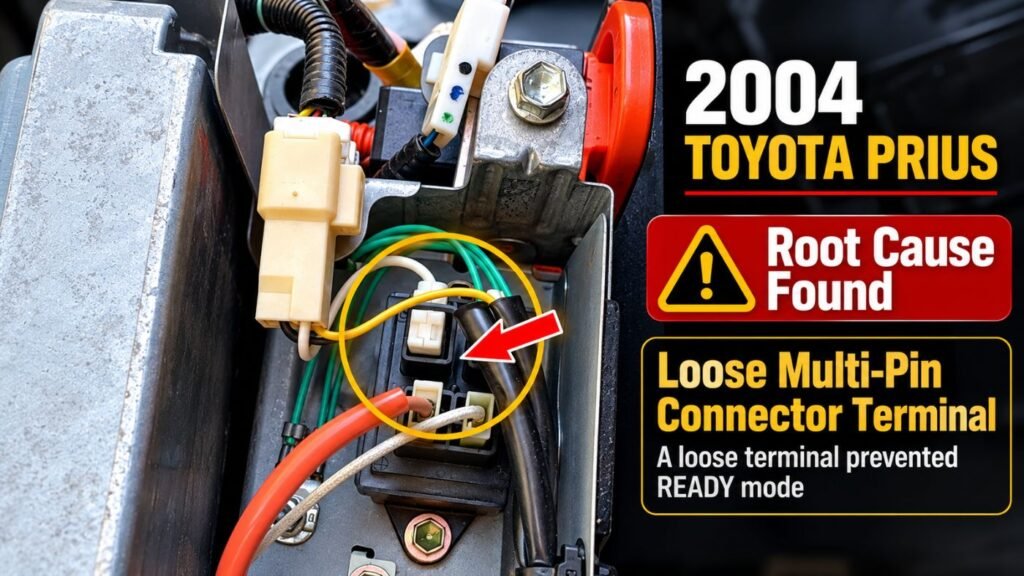
During this inspection, we discovered a slightly loose terminal pin inside a multi-pin connector connecting the vehicle’s wiring harness to the hybrid battery assembly.
Although the connector initially appeared properly installed, one of its terminals did not have a secure connection.
This type of electrical problem can be difficult to identify through a visual inspection alone.
An intermittent or poor terminal connection can interfere with relay control or monitoring circuits, potentially preventing the hybrid system from entering READY mode.
In this case, the loose terminal was the confirmed cause of the no-start condition.
Step 5: Repair and Final Verification
After identifying the loose terminal, we corrected and secured the electrical connection.
The result was immediate: the Toyota Prius successfully entered READY mode.
A follow-up diagnostic check confirmed that P0AA1 and P0AA4 were no longer present as active faults and did not return during the final verification.
No major parts replaced
No replacement of the PRA, hybrid battery ECU, inverter, or hybrid battery modules was required to resolve the no-start problem.
What This Case Teaches About Prius P0AA1 and P0AA4 Codes
P0AA1 and P0AA4 are associated with the hybrid battery’s main contactor circuits.
Although these codes can indicate actual contactor failures, the root cause is not always a defective relay.
Problems with electrical connections, wiring, or control circuits can also produce symptoms associated with the contactor system.
This Arlington repair demonstrates three important diagnostic lessons:
- Do not replace hybrid battery contactors based on fault codes alone. Proper testing is essential.
- A healthy hybrid battery can still be associated with a no-READY condition. The problem may originate in the vehicle’s wiring or electronic controls.
- Small connector problems can cause major hybrid-system failures. A single loose terminal can prevent an otherwise functional vehicle from starting.
By systematically testing the battery assembly and investigating the vehicle’s electrical connections, we identified the actual fault without unnecessary major component replacements. That is the same approach we use in all of our hybrid battery diagnostics: find the real cause first, then recommend repair only where it is needed.
Frequently Asked Questions
What does P0AA1 mean on a Toyota Prius?
P0AA1 indicates that the hybrid system has detected a problem associated with the positive high-voltage battery contactor circuit. A diagnostic inspection is necessary to determine whether the issue involves the contactor itself, its control circuit, or another electrical fault.
What does P0AA4 mean?
P0AA4 indicates a problem associated with the negative high-voltage battery contactor circuit. The code does not, by itself, establish that the contactor must be replaced.
Can a loose connector prevent a Prius from entering READY mode?
Yes. The Toyota Prius depends on several electrical control and monitoring circuits to authorize high-voltage system operation. A loose or damaged terminal in a relevant circuit can interfere with that process.
Does a Prius need a new hybrid battery when P0AA1 and P0AA4 appear?
Not necessarily. These trouble codes do not automatically indicate failed battery modules or a need for complete hybrid battery replacement. Accurate troubleshooting should come before expensive repairs. If you are unsure whether your battery is actually weak, see our guide to the signs of a failing hybrid battery.
Can DFW Hybrid Battery diagnose a Prius that will not enter READY mode?
Yes. DFW Hybrid Battery provides hybrid battery and related electrical diagnostic services in the Dallas–Fort Worth area, including Arlington, Fort Worth, Irving, Dallas and surrounding DFW communities. In Arlington, service is by appointment; the on-site diagnostic is $200, and 50% of it is credited toward the repair.
Hybrid Battery Diagnostics in Arlington, TX
At DFW Hybrid Battery, we focus on identifying the actual cause of hybrid battery and related electrical problems before recommending major repairs.
Our services include hybrid battery diagnostics, battery reconditioning, hybrid battery repair and replacement, and external charging services for compatible hybrid battery systems.
We offer mobile hybrid battery services throughout the Dallas–Fort Worth Metroplex, including service at customers’ homes, automotive repair shops, and other suitable locations. Arlington is in our by-appointment area: the on-site diagnostic is $200, with 50% credited toward the repair. See our hybrid battery price list and our hybrid battery service in Arlington, TX.
If your Toyota Prius is displaying hybrid-system warning lights, showing battery-related fault codes, or refusing to enter READY mode, professional diagnosis can help determine the next step.
More Repair Case Studies
- 2026 Hyundai Santa Fe Hybrid — deeply discharged battery recovered, no replacement (Garland, TX)
- 2011 Lexus RX450h — full hybrid battery rebuild with 30 cycle-tested modules (Grand Prairie, TX)
- 2008 Toyota Prius — P0AA6 isolation fault, battery replacement ruled out (Fort Worth, TX)
- 2021 Toyota Prius — deeply discharged hybrid battery recovered with external charging (Arlington, TX)
- 2017 Hyundai Sonata Hybrid — no-start diagnosis
- 2015 Hyundai Sonata Hybrid — P1B70 caused by a failed BMS
- 2006 Lexus RX400h — full hybrid battery rebuild
Technical note: Hybrid vehicle battery systems contain potentially lethal high voltage. Diagnosis and repair should be performed by qualified personnel using appropriate safety procedures and equipment.
Prius Won’t Go Into READY Mode?
Contact DFW Hybrid Battery before replacing contactors, the battery ECU or the battery itself. Diagnostics, reconditioning, repair, external charging and replacement — serving Arlington, Dallas, Fort Worth and surrounding DFW communities.
Quick Request — 30 Seconds
Four quick fields. We call or text you back.