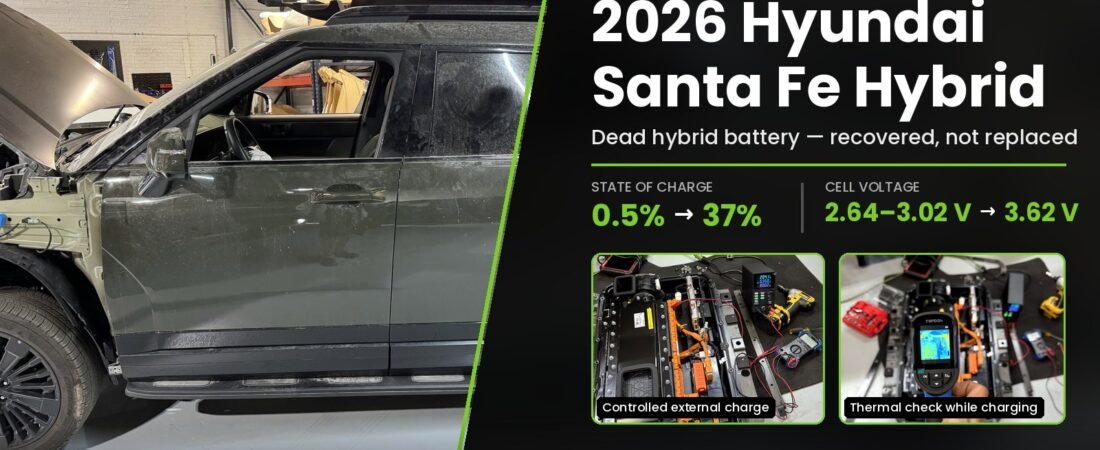
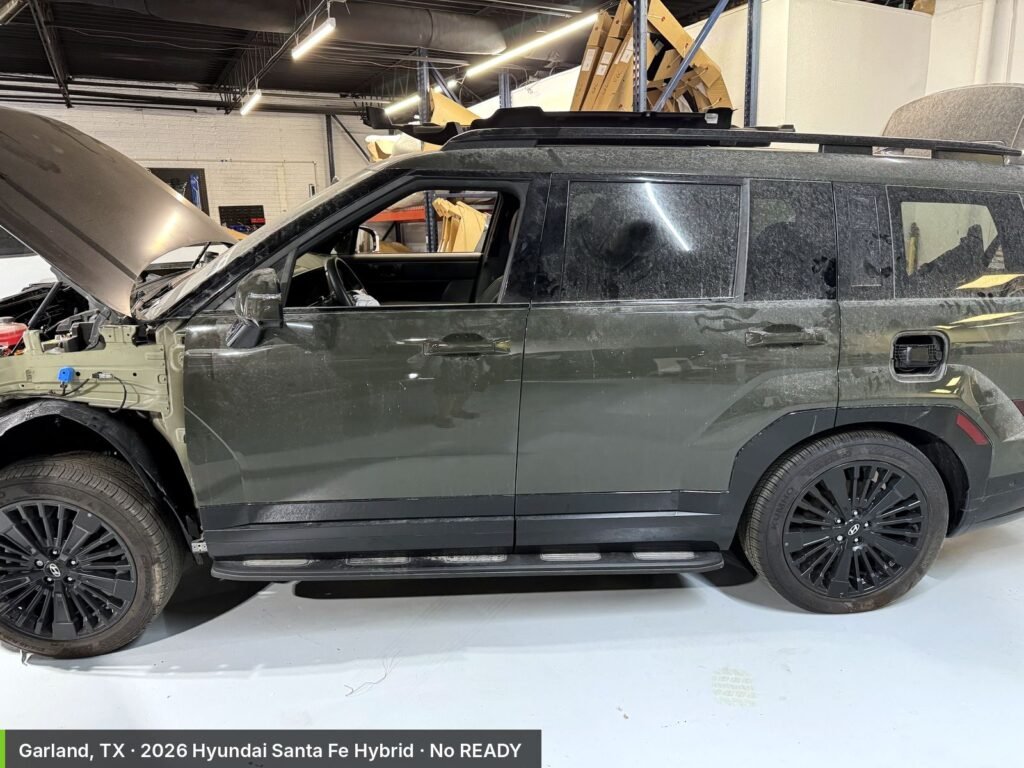
A 2026 Hyundai Santa Fe Hybrid at a Garland repair shop would not go READY, even after its engine had been fixed. The high-voltage battery was almost completely drained. Instead of replacing it, we tested it, recovered it with a controlled charge and proved the result on the road.
CASE STUDY
2026 Hyundai Santa Fe Hybrid — Deeply Discharged Battery Recovered in Garland, TX
Vehicle: 2026 Hyundai Santa Fe Hybrid (bought at auction)
Location: A repair shop in Garland, Texas
Problem: No READY — the high-voltage battery was deeply discharged (SOC 0.5%) after engine problems
Service: Battery check, controlled external charge with temperature monitoring, reinstall and road test
Result: READY on the first try, normal charging, EV mode and a 20-minute road test — no battery replacement
Quick Answer
Symptom: The engine had already been repaired by the shop, but the Santa Fe still would not go READY.
Key finding: Battery management data showed 0.5% state of charge, a pack voltage of 201.4 V and cell voltages from 2.64 V to 3.02 V — too low for the hybrid system to start.
What we did: Removed the pack, charged it slowly from an external source while watching voltage, current and temperature, then reinstalled it.
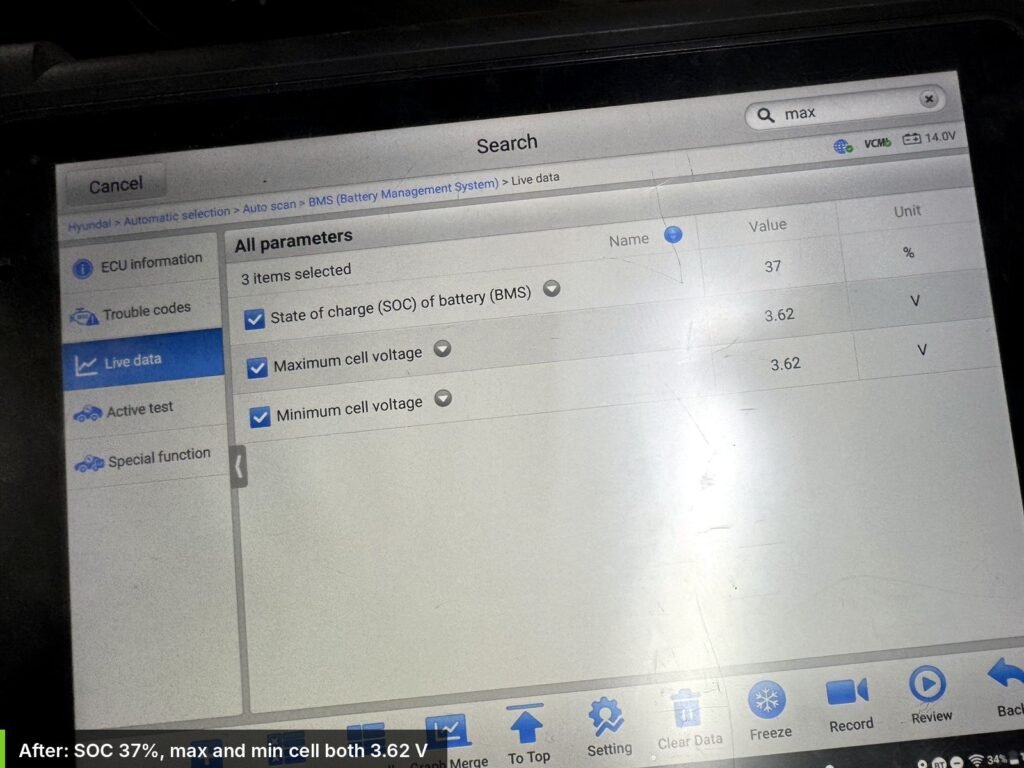
Result: The SUV went READY on the first attempt. Within about 10 minutes the highest and lowest cell voltages matched (3.62 V), and state of charge later reached about 37%.
Customer outcome: The shop got the vehicle back running, without buying a new hybrid battery.
The Problem: Engine Fixed, but Still No READY
This Santa Fe Hybrid was bought at auction and came into a repair shop in Garland, Texas, with a no-READY condition. The shop diagnosed and repaired the gasoline engine, but the SUV still would not start. The reason: the high-voltage hybrid battery had been drained too far for the hybrid system to start.
A new hybrid battery is a big expense. Before anyone ordered one, the shop called DFW Hybrid Battery to find out whether the pack itself was bad or just empty.
Step 1: Reading the Battery Management Data
Jay connected a professional scan tool to the battery management system (BMS). The numbers explained the no-start:
| Reading | Before recovery |
|---|---|
| Vehicle status | Would not go READY |
| State of charge (SOC) | 0.5% |
| Battery DC voltage | 201.4 V |
| Highest cell voltage | 3.02 V |
| Lowest cell voltage | 2.64 V |
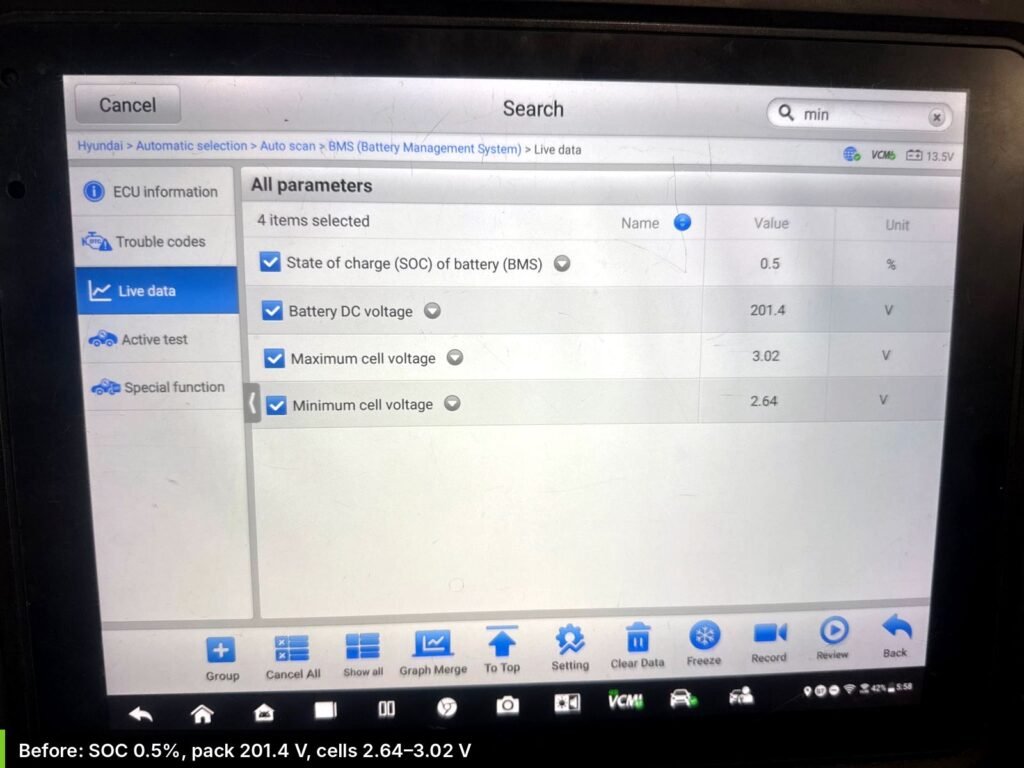
At this level the battery could not support a normal hybrid start. The question was whether the cells were damaged or only discharged.
Step 2: Diagnose Before Charging
The pack was removed from the vehicle so it could be inspected and charged safely. Before and during the recovery we watched:
- Live battery data from the BMS
- How the cell voltages behaved
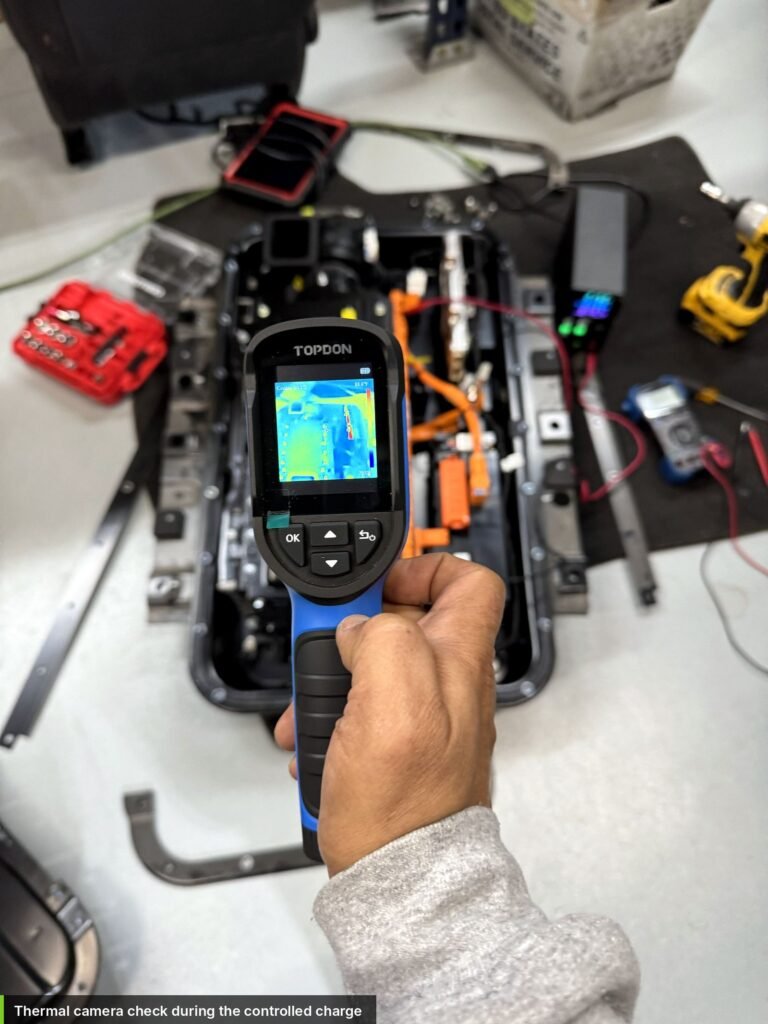
- Pack temperature, checked with a thermal camera
- The physical condition of the pack and its connections
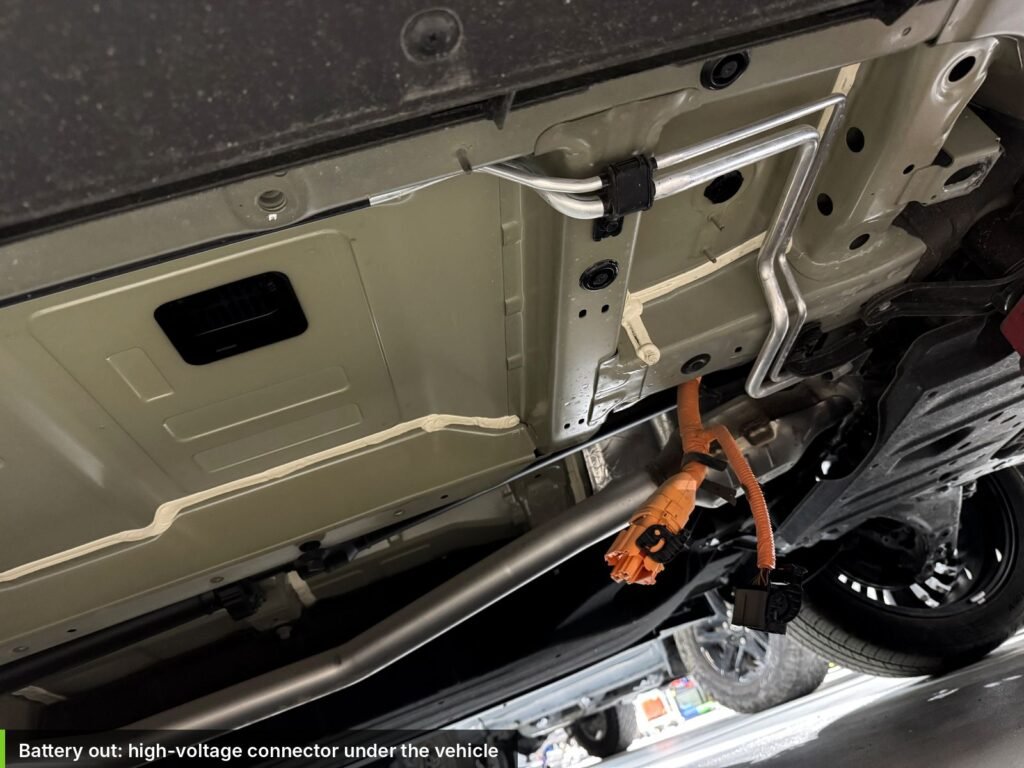
Step 3: Controlled External Charge
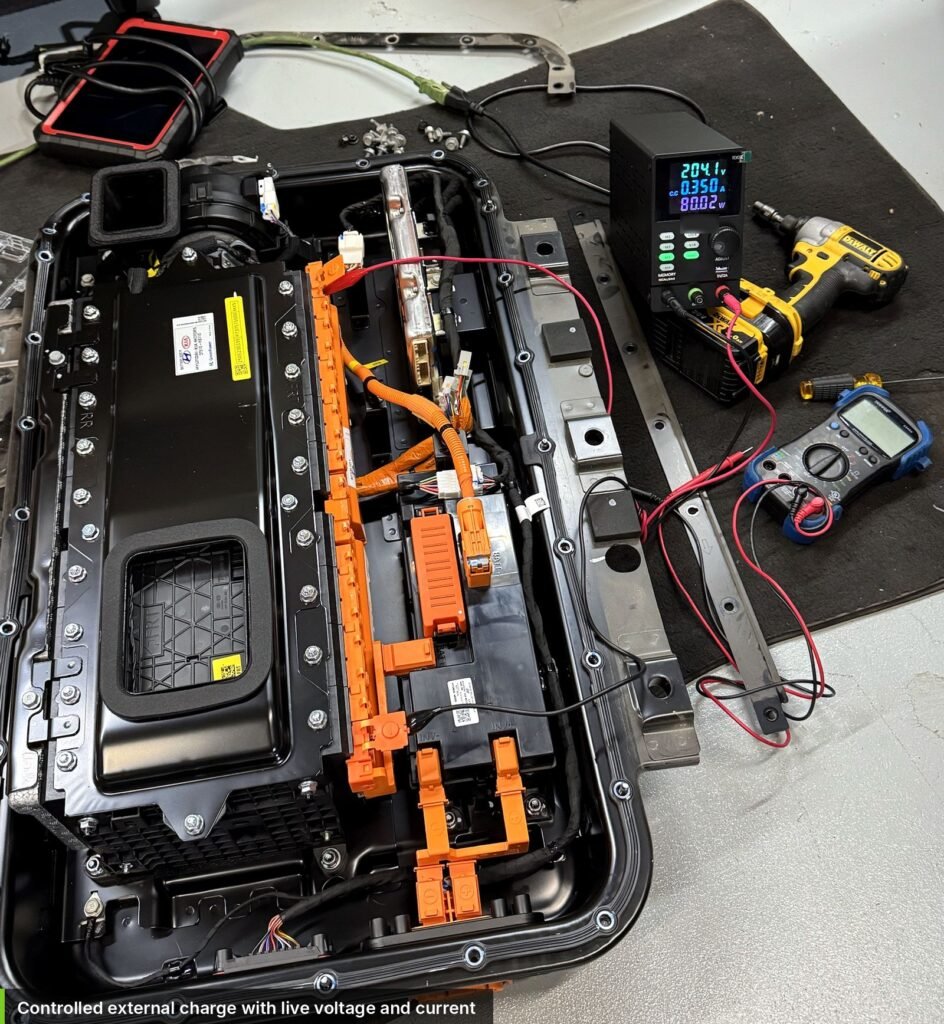
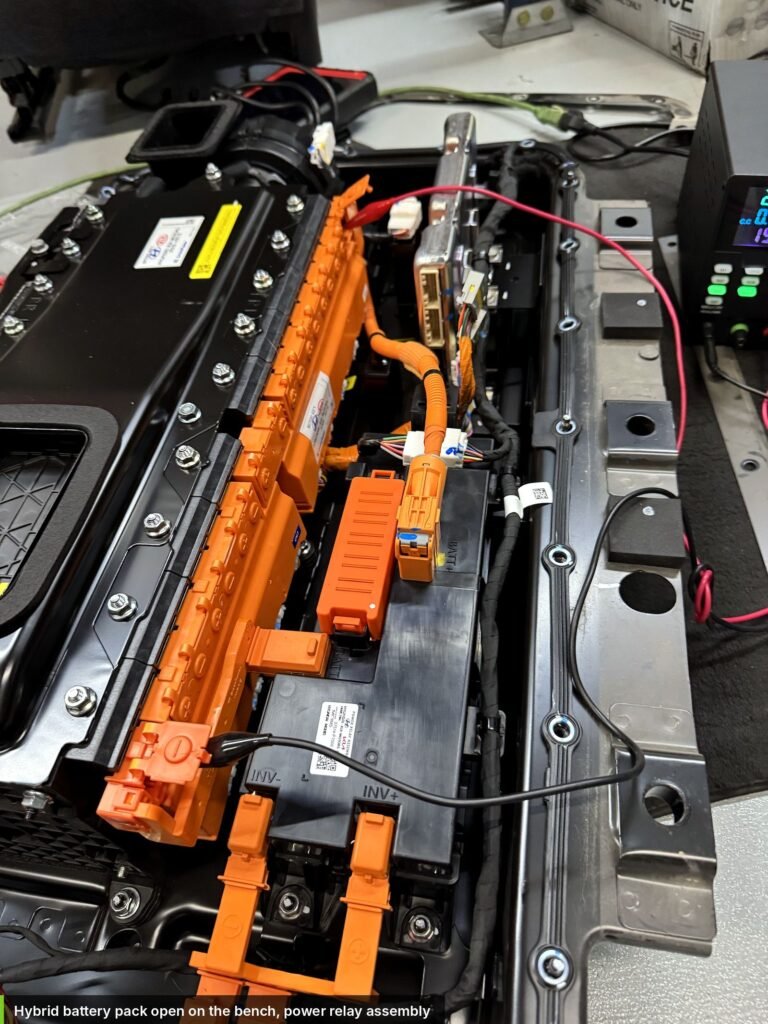
A deeply discharged lithium-ion pack should never be rushed. We charged it from an external power supply at a low, controlled current, with voltage, current and temperature in view the whole time:
- Charged slowly under close monitoring (in the photo: about 204 V at 0.35 A)
- Pack voltage raised to about 250 V
- Temperature checked throughout with the thermal camera
- Goal: enough energy for the vehicle to start, so the hybrid system can take over charging normally
Step 4: Reinstall, Start and Verify
With the pack at a usable level, it was reinstalled and the Santa Fe was tested:
- READY on the first start attempt
- The gasoline engine began charging the hybrid battery normally
- After about 10 minutes, live data showed the highest and lowest cell voltages matching at 3.62 V
- State of charge rose to about 20%, then to about 36.5–37%
- The vehicle switched into EV mode normally
- A 20-minute road test was completed with no problems
| Reading | Before | After |
|---|---|---|
| State of charge | 0.5% | 36.5–37% |
| Highest cell voltage | 3.02 V | 3.62 V |
| Lowest cell voltage | 2.64 V | 3.62 V |
| Vehicle status | No READY | READY, EV mode, road test passed |
After final testing, the Santa Fe went back to the repair shop in proper working condition.
Why This Case Matters
A dead hybrid battery is not always a bad hybrid battery. Here the real problem was an engine fault that let the battery drain too far. Once the engine was fixed and the pack was recovered carefully, the hybrid system went back to normal — and the shop avoided buying a battery the car did not need.
For repair shops
If a hybrid comes in with no READY after engine or electrical work, check the battery’s state of charge and cell voltages before quoting a new pack. We can come to your shop, test the battery, and recover it when the data shows that is possible.
Frequently Asked Questions
Can a deeply discharged hybrid battery be recovered?
Sometimes. If the cells are not damaged, a slow, controlled external charge can bring the pack back to a level where the car can start and charge itself again. It is not guaranteed — a cell that sat too low for too long may not recover — which is why the pack has to be tested and watched, not just charged. See our hybrid battery charging service.
Why does a hybrid battery drain this far?
Common causes are a car that sits for a long time, repeated start attempts while another fault keeps the system from running, or an engine problem that stops the hybrid system from charging the battery. In this case the Santa Fe came from auction with engine problems.
Does a no-READY Santa Fe Hybrid need a new battery?
Not automatically. Check the state of charge, pack voltage and cell voltages first. In this car the pack only needed a careful recharge once the engine was fixed.
How much does an external hybrid battery charge cost?
External pack charging starts at $300, tax and mobile service included. See our hybrid battery prices.
Do you work with repair shops in Garland?
Yes. We come to independent shops and dealerships as well as to drivers. Garland visits are by appointment: the diagnostic is $200, and 50% of it is credited toward the repair. See hybrid battery repair in Garland.
Hyundai Hybrid Battery Service Across DFW
DFW Hybrid Battery provides mobile hybrid battery diagnostics, charging, repair and replacement across Dallas–Fort Worth, including Garland, Richardson, Mesquite and Dallas. See also our Hyundai hybrid battery guide and Hyundai & Kia hybrid codes.
More Repair Case Studies
- 2011 Lexus RX450h — full hybrid battery rebuild with 30 cycle-tested modules (Grand Prairie, TX)
- 2008 Toyota Prius — P0AA6 isolation fault, no battery sold without proof (Fort Worth, TX)
- 2021 Toyota Prius — deeply discharged hybrid battery recovered with external charging (Arlington, TX)
- 2004 Toyota Prius — P0AA1 & P0AA4 no-READY traced to a loose connector terminal (Arlington, TX)
- 2017 Hyundai Sonata Hybrid — no-start diagnosis
- 2015 Hyundai Sonata Hybrid — P1B70 caused by a failed BMS
Technical note: Hybrid battery packs carry potentially lethal high voltage, and deeply discharged lithium-ion cells must be charged with care. Removal, external charging and testing should only be done by qualified personnel with proper safety procedures and equipment.
Hybrid Won’t Go READY?
Drivers and repair shops: test the battery before you replace it. Diagnose first — replace only when necessary.
Quick Request — 30 Seconds
Four quick fields. We call or text you back.